
Chamber One · 01 of 22 · Part I — People & Mind
The Spark of Inquiry
“What becomes possible when humanity begins asking wiser questions?”
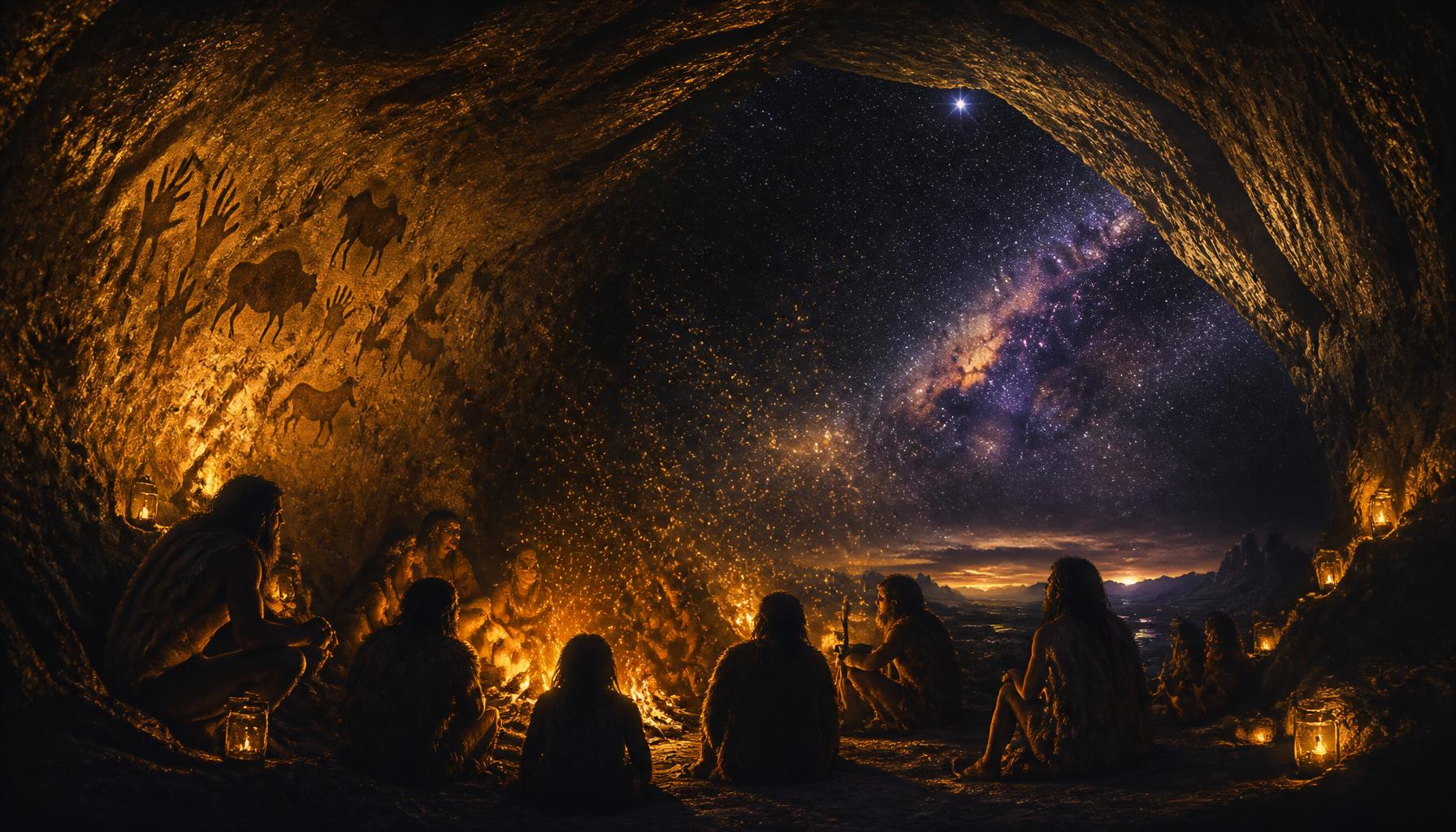
A question can begin as quietly as a spark. It may rise from wonder, grief, frustration, love, or the sense that life holds possibilities we have not yet recognized. Stay with a meaningful question and it starts to light the patterns beneath our choices. That small light can become a path.
Enter the InquiryOpening
A Fogbow Above My Brother's Memorial
My younger brother Quinn, who everyone called Q, died on July 13, 2013. We shared curiosity, long conversations, humor, and a stubborn hope for what people might yet become. Grief has its own weather. For a long while I lived inside it without much language for what I was moving through, and underneath the ordinary days I carried a question I could not set down.
Four years later, on July 13, 2017, a fogbow appeared above his memorial. A fogbow forms the way a rainbow does, though the droplets in fog are small enough that the colors soften into a wide pale arc. Knowing that did not make the morning ordinary. I have never settled on a single meaning for it, and I would rather not. Love, memory, wonder, and grief arrived together, and I understood that a question had been walking beside me for most of my life.
I began exploring peace and the systems people build during my youth, through a Peace Campaign. Even then I noticed that what wore people down was rarely the world itself. It was the arrangements we make around each other: the rules, the hierarchies, the shortcuts, the habits nobody remembers choosing.
Under that luminous arc the question finally said itself plainly. Why do people make life harder for each other? That question became the seed of this book, and it runs beneath all twenty two chambers. Q's presence is still a guiding light in the work, and the question he helped awaken is the one I offer you first.
Section II
Wonder, Curiosity, and Inquiry
Wonder opens perception. It arrives without being summoned, usually when we are not busy defending an opinion. A hawk turning on a thermal, a child's question at breakfast, a familiar road looking unfamiliar in low light. For a breath the aperture widens and we see more than we expected to see.
Curiosity moves toward what has opened. It picks up the stone, follows the creek upstream, reads the second article, walks over to the neighbor to ask how the garden survived the heat. Curiosity is wonder with legs, and it is how most of what we know arrived in our hands.
Inquiry stays. It keeps a question alive past the first easy answer and the second convenient one, gathering knowledge through observation, reflection, conversation, research, and lived experience. Inquiry is patient enough to let evidence accumulate and honest enough to let our own assumptions surface.
These three movements weave through daily life and through the long history of what humanity has built. A gardener wonders why one bed thrives, becomes curious about the soil, then inquires season after season until she knows the living network feeding her plants. The same sequence built boats, medicines, music, and law. It is ordinary, and it has carried us a long way.
Section III
Why Ask Why?
Questioning served survival long before it became philosophy. People read weather in the color of the sky and the behavior of animals because someone kept asking what came before a storm. Plants were tested and remembered. Seeds were selected. Shelters were rebuilt after each failure taught something. Illnesses were traced to their sources. Injustice was named by people willing to ask who a rule actually protects.
The quality of a question shapes the range of answers we can perceive. Ask why a neighborhood is failing and you will collect a list of faults. Ask what this neighborhood needs in order to thrive and you will collect a list of possibilities. Both questions are honest, and they open different doors.
Asking well does not hand us wisdom. A sincere question also asks for humility, reliable evidence, the knowledge held by people living closest to the situation, ethical reflection, and a willingness to revise what we thought we knew. Inquiry expands perception and reveals choices. What we do with those choices remains ours.
Section IV
The Questioning Mind
Much of the time the mind runs on prediction. It builds a working model of the world and leans on it, which is why we can drive a familiar road while thinking about something else. That efficiency has a cost. We can pass the same broken thing for years without seeing it.
A genuine question interrupts the model. Research on curiosity suggests that wanting to know something is associated with better memory for what follows, and that interest can support attention, learning, and flexible thinking. Interest is not decoration. It appears to be part of how learning works.
Holding an open question is uncomfortable, which is why inquiry asks for a little courage alongside interest. The mind would rather close the loop, and it will accept a thin answer over an open question if we let it. Staying with the discomfort long enough for something truer to arrive is a practice, and it improves.
It is also why we need each other. No single mind sees around its own assumptions. A question shared with people who see differently becomes a wider instrument, and knowledge gathered that way tends to hold up over time.
Section V
How Do We Truly Improve?
Consider the ox. For thousands of years a farmer walked behind one, working a field at the pace of an animal that had to be fed, rested, and known well. Then came the tractor, and a morning could accomplish what once took a week. Now the machine is air conditioned and satellite guided, planting, spraying, and reporting yield from the same seat. By any measure of output that is a remarkable achievement, and I have no wish to romanticize the ox or the aching back of the person behind it.
The honest question is what traveled with those gains and what quietly did not. Fields grew larger and soil grew thinner in many places. Fuel replaced fodder. Skill held in the body became skill held in a manual. Farms consolidated and small towns lost the families who filled their schools. Output rose. Other things fell.
So the measure of improvement has to be larger than speed and volume. When we ask a fuller set of questions about a change, the answers become more useful.
- Does it support life?
- Does it preserve or restore resources?
- Does it strengthen health and human dignity?
- Does it increase resilience?
- Does it serve future generations?
- Does it move humanity toward balance?
A change that answers yes across those questions has earned the word improvement. A change that answers yes to one and no to the rest is a trade, and trades deserve to be named plainly so we can decide whether we want them.
Invention becomes worthy progress when intelligence, responsibility, usefulness, and care travel together. We already know how to be clever. The work ahead asks us to be clever and wise in the same motion, which is harder and far more interesting.
Section VI
Five Reflection Questions
Question 01
“Which question has quietly followed you through your life?”
Question 02
“Where has wonder changed the way you see?”
Question 03
“What familiar part of life deserves fresh inquiry?”
Question 04
“How would your choices change if improvement were measured by the health of the whole?”
Question 05
“What question could open a new path for your family, community, or world?”
Section VII
A Living Example: Catching Water From Fog
Along the dry coastal hills of northern Chile, fog moves inland most mornings and burns off by midday while wells run low and water arrives by truck. The observation was ordinary. Everyone saw the fog. The question was less ordinary. If the fog carries water, can we catch it before it leaves?
Researchers and villagers tested it with materials at hand. Mesh panels were stretched between posts on ridges where the fog actually traveled. Droplets gathered on the fibers, ran into a gutter, and filled a tank below. Early panels tore in high wind, so the mesh and the framing changed, and the placement was adjusted by watching rather than guessing. At El Tofo in the 1980s and 1990s, a village fog collection system supplied daily water for hundreds of people, and the approach has since been adapted in other arid regions.
The knowledge that came from it is specific and shareable. Ridge placement matters more than panel size. Storage and simple filtration matter as much as collection. Communities that maintain the nets together keep them working far longer than installations left to one owner.
Observation, question, experiment, knowledge, practical response, shared benefit. That sequence belongs to all of us, and it usually begins when someone declines to accept that water passing overhead every morning is none of our business.
Section VIII
Living Solutions
Practices small enough to begin this week, sturdy enough to change how you see.
01
Keep a question journal
One page, one question, no answer required. Date it and return in a season to see how the question has grown while you were living.
02
Gather a small question circle
Six or eight people, one question, each person speaking once before anyone speaks twice. The room usually learns something no single person carried in.
03
Ask children what they notice
Children have not yet learned which questions are supposed to be off limits. Ask what they see, then stay quiet long enough to hear the whole answer.
04
Examine one familiar system with fresh eyes
A water bill, a school schedule, a grocery aisle, a stretch of roadside. Ask who designed it, what it assumes, and who it serves well.
05
Explore credible perspectives
Read the researcher, the practitioner, and the person living with the outcome. Where those three agree you have something sturdy. Where they differ you have your next question.
06
Turn one worthy question into a small experiment
A rain barrel, a shared tool shelf, a soil test, a neighborhood meal. Small enough to begin this month, real enough to teach you something reading could not.
07
Record what the experiment teaches
Write down what worked, what failed, and what surprised you. Plain notes turn a single attempt into knowledge someone else can use.
08
Share the discovery with this community
What you learn in your kitchen or your watershed belongs to more people than you. Bring it back so others can build on it.
Section IX
A Question With Humor
“If humanity received a cosmic performance review, which question would be written in the margin?”
Section X
Author Reflection
I am not writing from the far side of these questions. I am somewhere in the middle of them, the same as you. Inquiry has kept me company through art and building, through family and grief, through environmental work that taught me how slowly land forgives and how generously it recovers when we help, and through the long years of gathering this book.
What I have learned is modest. A worthy question does not solve a life. It accompanies one. It walks with you through seasons you did not plan for and shows a little more each time you are ready to see it, asking only that you keep it honest.
Q's life helped awaken the question I carry, and that question has since given me most of what I care about. I would rather have my brother. Since I cannot, I will keep asking why we make life harder for each other, and I will keep looking for the ways we can make it lighter.
So ask the question you have been carrying. Say it out loud to someone. A worthy question will walk beside you until you grow capable of meeting its answer.
— Colleen Powers
Section XI
Questions to Carry
“What are we becoming through the questions we ask?”
“How do we improve in ways that strengthen life?”
“What question is waiting for your attention?”
Section XII
Add Your Question to the Living Inquiry
What question do you believe humanity needs to explore now?
Continue
Continue the Journey
Previous Chamber
The threshold begins here
Return to all Chambers
The full map
Next Chamber →
Chamber II
Awareness and Attention