
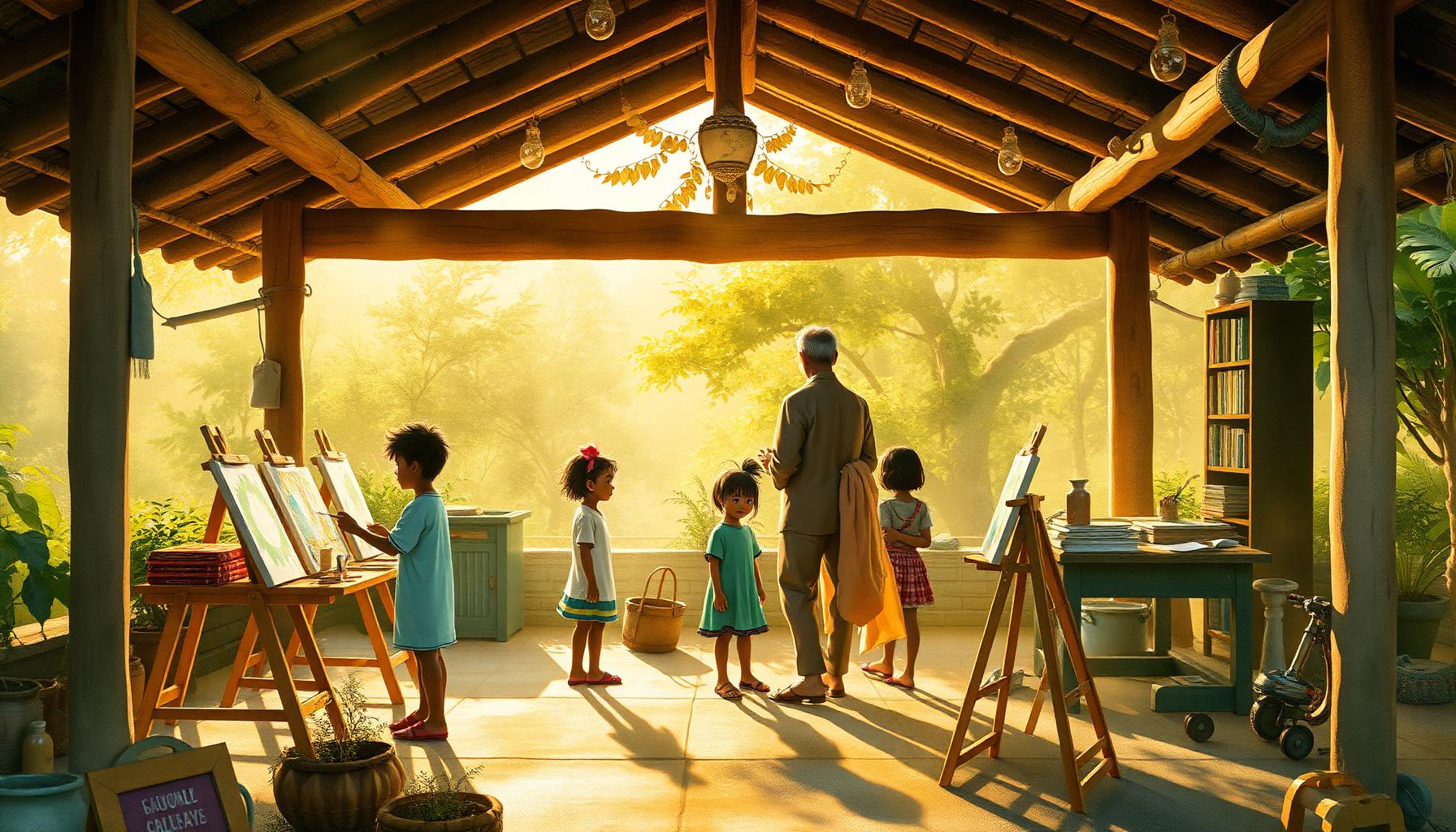
Pillar VI · 06 of 12
Education Reimagined
Learning that awakens inquiry, mastery, character, and contribution.
Mission
To make education the lifelong cultivation of curious, capable, and contributing human beings — not the assembly line of credentials it became.
Vision
Every child grows up immersed in real work, real questions, real elders, and real making — and every adult continues learning all their life.
Why It Matters
The case for renewal
Children are designed to learn through immersion, apprenticeship, and meaningful contribution. Industrial schooling, however well-intentioned, has thinned all three.
The world needs people who can think, build, repair, lead, listen, and create — skills the current system rarely measures and often suppresses.
Reimagining education is the most generative act available to a community; everything else flows from the citizens it shapes.
Current Challenges
What stands in the way
- 01Schools severed from the communities and trades that once surrounded them.
- 02Curricula optimized for testing rather than capability.
- 03Disappearance of vocational, artistic, and outdoor education.
- 04Teacher burnout from impossible role expansion.
- 05Adult learning fragmented and largely commercialized.
Practical Solutions
What we are building
01
Inquiry-Based Core Curriculum
Replace passive coverage with deep, question-driven study in literacy, mathematics, science, history, and the arts.
02
Trades, Arts & Ecology Labs
Every school includes working shops, gardens, kitchens, studios, and forests — places where mastery is taught by people who do the work.
03
Community Apprenticeship Network
Every student spends meaningful weekly time apprenticing with local makers, healers, builders, farmers, scientists, and elders.
04
Character & Civic Formation
Explicit, non-sectarian cultivation of integrity, courage, generosity, deliberation, and self-governance.
05
Lifelong Learning Commons
Public libraries reimagined as adult learning hubs: courses, mentors, makerspaces, language circles, and credential pathways.
Implementation Strategy
A path you can walk
- 01Phase 1 — Listen. Convene teachers, parents, students, and community members.
- 02Phase 2 — Launch one pilot school redesigned around inquiry, trades, and apprenticeship.
- 03Phase 3 — Open the apprenticeship network with founding employer-mentors.
- 04Phase 4 — Renovate the public library into a lifelong learning commons.
- 05Phase 5 — Train teachers and replicate across the district.
Pilot Community
What it looks like
A district reorganized around an inquiry-based curriculum, weekly apprenticeships in 40+ local trades, and a community learning commons open to every adult resident.
The Benefits
Economic. Environmental. Communal.
Economic
- ✦Workforce prepared for skilled, meaningful, locally-rooted work.
- ✦Reduced reliance on remedial training after graduation.
- ✦Lifelong learners better adapted to economic change.
Environmental
- ✦Generations literate in ecology, food, and energy systems.
- ✦Schools as living models of regenerative design.
- ✦Stewardship as a daily practice, not an abstraction.
Community
- ✦Children who know their neighbors as teachers.
- ✦Adults who keep growing all their lives.
- ✦A civic culture capable of deliberation and repair.
Gallery & Videos
Coming into view
Photographs, films, and project documentation will populate this gallery as pilot communities take shape.
01 · Coming soon
02 · Coming soon
03 · Coming soon
04 · Coming soon
05 · Coming soon
06 · Coming soon
Downloadable Resources
Tools for builders
- Inquiry Curriculum FrameworkComing soon
- Apprenticeship Network PlaybookComing soon
- Learning Commons Design GuideComing soon
Frequently Asked Questions
Honest answers
›Will graduates be college-ready?
Yes — and more so. Students from inquiry-based, apprenticeship-rich programs outperform peers on most measures, including college success.
›What about standardized testing?
The model meets state standards while exceeding them. Tests become floors, not ceilings.
›How are teachers supported?
Smaller loads, real planning time, mentor networks, and a culture that treats teaching as the master craft it is.
Closing Reflection
“The point of education is not to fill a vessel but to kindle a flame.”
— An elder teacher
A community is only as wise as its learning. Build the schools you wish you had attended, and a generation will return the favor.
Continue the Journey